

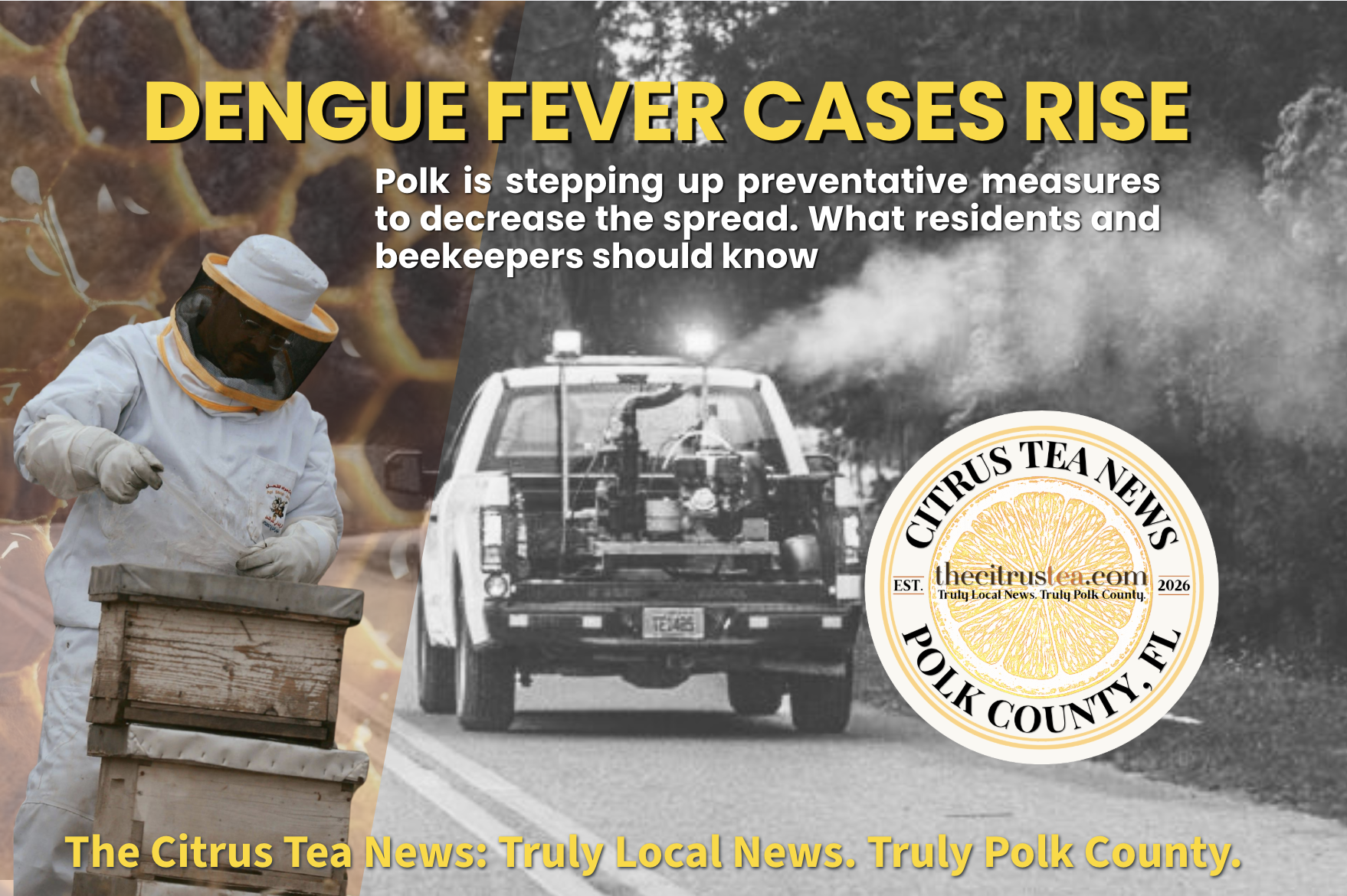
Polk County Steps Up Mosquito Spraying as Dengue Cases Climb Nearby: What Residents and Beekeepers Should Know

Polk County Mosquito Control has increased truck spraying and added helicopter spraying as dengue fever spreads in neighboring counties. It has also stepped up trapping, testing, and home inspections.
No locally acquired dengue cases have been reported in Polk this year.
County officials say the best protection starts in residents’ own yards. Their message focuses on what residents can do to lessen the spread of mosquitoes and mosquito-borne illness like dengue.
“The species of mosquito that can transmit dengue thrives around your home,” said Jackson Mosley, who holds a doctorate and manages the division.
Breeding, he said, can happen in as little as a bottle cap of water.
The mosquito that carries dengue is not a swamp mosquito. It breeds in the things people keep in their own yards: plant saucers, bromeliads, buckets, tarps, boat covers, birdbaths, clogged gutters, toys, tires and trash bins.
A spray truck passing down the street at night kills the adults flying at that moment. It does not empty the saucer under the potted fern.
Dengue Cases Identified in Neighboring Counties
Polk is responding to what is happening nearby as a preventative measure. In the Florida Department of Health’s arbovirus surveillance report for the week of Sept. 6 to 12, the state counted 41 locally acquired dengue cases. The year to date in Florida shows Hillsborough County had 134 locally acquired cases; Miami-Dade and Pinellas both had seven; Pasco had two; and Orange and Palm Beach each had one.
Polk was not listed among counties with locally acquired dengue, and as of that report, was not under a state health advisory or alert.
As of Sept. 23, the state had not posted its report for Sept. 13 to 19. Bay News 9 reported on Sept. 21 that Polk had no active dengue cases and that Hillsborough had confirmed its first dengue-related death. In Orange County, which also borders Polk, the health department issued a mosquito-borne illness alert Sept. 18 after confirming two more locally acquired cases.
Dengue is not contagious between people. It spreads only through bites from an infected mosquito. Symptoms show up three to 14 days after infection and resemble the flu: fever, muscle aches, joint pain. Most people recover, but a small share develop a severe form that requires hospital care.
Chemicals Used by Polk County
Polk County names one primary adulticide called permethrin, a chemical that kills adult mosquitoes in flight.

This chemical is a synthetic version of a compound found naturally in chrysanthemum flowers. It belongs to a family called pyrethroids. If you have used an over-the-counter household bug spray or treated a dog for fleas, you have likely handled something related.
Spraying happens at night. The county says adulticiding “is done at night when adult mosquitoes are most active, which is also when most non-target insects like bees, dragonflies and butterflies are not as active.”
The county does not spray on request or on a fixed rotation. “Spraying for adult mosquito outbreaks occurs only on an as-needed basis and only if mosquito populations meet State guidelines for treatment,” it says, and zone selection comes from weekly trap data.
Beekeepers Beware
Update, Sept. 23, 2026: This story has been updated to add Polk County Mosquito Control’s spray list for the week, as posted on the county’s website Sept. 23. Sprays listed for Sept. 22 had not been marked as completed at that time. Spray dates depend on weather and trap counts and may change.
Permethrin is highly toxic to bees, according to the National Pesticide Information Center, an EPA-funded center at Oregon State University.
Timing helps, but is not the whole answer. Bees near the hive entrance, colonies close to a road, and hives in the path of a helicopter run can all still be exposed. That is why the practical question for a Polk beekeeper is simple: how do I know the truck is coming?
Polk’s website says Mosquito Control alerts the beekeeping community when it plans to spray, but it does not say how a beekeeper gets on that list or how much notice is given. The Citrus Tea News could not find a sign-up form and has reached out to the county.
The county posts a spray schedule listing truck zones by number and community name, with a note that dates depend on weather and trap data and that zones may be rescheduled. But that page lists no times of day and does not separate helicopter flights from truck routes. When we checked Sept. 21, the most recent entries were still dated Sept. 9 and Sept. 10, before the Sept. 15 announcement of increased spraying. The page has since been updated with sprays from Sept. 14 through Sept. 21. As of Sept. 23, four sprays scheduled for Sept. 22 were still listed as upcoming.
| Date | Area | Zone | Status |
|---|---|---|---|
| Sept. 21 | Alturas | 35 | Completed |
| Sept. 21 | Frostproof | 39 | Completed |
| Sept. 21 | East Lake Wales | 24A | Completed |
| Sept. 22 | Cypress Lakes | 1 | Scheduled, not yet listed as completed |
| Sept. 22 | Skyview | 17A | Scheduled, not yet listed as completed |
| Sept. 22 | K-Ville | 17B | Scheduled, not yet listed as completed |
| Sept. 22 | Lake Rosalie | 24B | Scheduled, not yet listed as completed |
We also could not find a spray notification sign-up for residents or any process to request that a property not be sprayed.
Hillsborough County, which borders Polk, lets beekeepers and residents sign up for email or text alerts, usually a few hours before spraying, and published guidance for hive owners on Sept. 10. Volusia County adds registered beekeepers to a courtesy notification list. Both are voluntary programs run by the local mosquito control agency.
The Citrus Tea News asked Polk County Communications whether such a list exists, how a beekeeper would join it, how much notice members receive, whether residents can sign up as well, and whether beekeepers received any notice before the spraying that has already happened. This story will be updated when the county responds.
Registering hives with the Florida Department of Agriculture and Consumer Services is required by state law, but that registration is an apiary inspection and colony health program. This has nothing to do with a spray notification list or system. Nothing in Chapter 586 of the Florida Statutes requires anyone to warn a beekeeper before pesticide application.
Any advance notice a Florida beekeeper receives comes from their local mosquito control program by choice, not by law.
For now, a Polk beekeeper’s best option appears to be calling the division directly at 863-534-7377 and asking when their zone is scheduled.
What beekeepers can do in the meantime, according to the University of Florida IFAS Extension and guidance published by Hillsborough County:
- Cover hives loosely. Lay a piece of plywood over the top so it extends past the sides.
- Do not wrap or seal a hive in plastic. This mistake traps heat and can kill the colony outright, which is a far worse outcome than the spray.
- Adding an empty super before treatment gives bees more room away from the entrance.
- Where possible, keep hives at least 300 feet from roads with the entrances facing away.
Are the Pesticides Safe?
Federal agencies say yes when products are used as labeled, and that most precautions are optional rather than necessary.
The EPA says adulticides “can be used for public health mosquito control programs without posing risks of concern to the general population or to the environment when applied according to the pesticide label,” and that its reviews confirm label directions do not pose risks to vulnerable groups including children and pregnant women.
The federal Centers for Disease Control and Prevention is more conversational. On truck spraying: “If people prefer to stay inside when spraying takes place, they can, but it is not necessary.” On pets: “The spray does not harm pets, but you may choose to bring them inside when spraying occurs.” On asthma: “When truck spraying is done correctly, it does not cause asthma attacks.” On aerial work: “You do not need to leave an area during aerial spraying.”
The CDC does name one potential side effect for humans. Being outdoors during spraying can cause eye irritation.
Permethrin itself carries cautions that are less about people than about other living things. Besides bees, it is highly toxic to fish and other aquatic animals. It is low-toxicity to birds. On skin, people may notice irritation, tingling, or itching.
Permethrin is genuinely dangerous to cats, but the documented poisonings involve concentrated flea treatments containing 45% to 65% permethrin applied directly to the animal rather than from a dilute nighttime fog.
What Residents Should Do on Spray Night
None of this is required, but this is what a cautious household can do.
- If you would rather not be in it, go inside and close the windows. Turn off window fans and anything else pulling outdoor air in, or switch the air conditioner to recirculate.
- Bring pets in if you prefer. Federal guidance says the spray does not harm them.
- If you have an ornamental fish pond, consider covering it overnight. Pyrethroids are hard on fish and aquatic life.
- Wash homegrown fruit and vegetables before storing, cooking or eating them.
- If you have asthma or known chemical sensitivities, staying indoors during spraying is the sensible call.
- If you feel unwell after spraying, contact your doctor. For a suspected exposure, Poison Control is 800-222-1222.
What Works Best to Protect People and Animals
Mosquito control staff will say it before anyone asks: the yard matters more than the spray truck.
The county advises residents to drain and cover.
- Drain standing water from tires, buckets, planters, toys, birdbaths, and trash bins. Repair damaged window and door screens. Wear long sleeves, pants, socks and shoes at dusk and dawn. Use an EPA-registered repellent.
- On repellents, the CDC recommends products containing DEET, picaridin, IR3535, oil of lemon eucalyptus, para-menthane-diol or 2-undecanone. Do not use oil of lemon eucalyptus or para-menthane-diol on children under 3 years old.
- When applying repellent to a small child, apply it to your hands first, then to the child’s face, and keep it away from hands, eyes, mouth, and any broken or irritated skin. If you are also using sunscreen, apply sunscreen first.
To request service or report standing water in your area, call Polk County Mosquito Control at 863-534-7377 or use the service request form on the county website. One caveat from the county: calls do not determine where trucks go. “The number of phone calls for service does not determine when or where treatment for adult mosquitoes will be done.” Trap data does.

Your community. Your news. Your right to know. The Citrus Tea News.
Follow us on Facebook and Subscribe at thecitrustea.com for breaking news and weekly updates from The Citrus Tea News.
Frequently Asked Questions
Are there dengue cases in Polk County?
As of the Florida Department of Health’s report for Sept. 6 to 12, no locally acquired dengue cases had been reported in Polk County this year. The state’s next report had not been posted as of Sept. 23.
How does dengue spread, and what are the symptoms?
Dengue spreads only through bites from an infected mosquito and is not contagious between people. Symptoms appear three to 14 days after infection and include fever, muscle aches and joint pain.
Is mosquito spray safe for people and pets?
The EPA says mosquito spray does not pose risks of concern to the general population when applied according to the label. The CDC says staying inside is not necessary, the spray does not harm pets and correctly done truck spraying does not cause asthma attacks.
How do I find out when Polk County is spraying my area?
Polk County posts a spray schedule on its website listing zones and dates, but not times of day. Residents can also call Mosquito Control at 863-534-7377.
How can beekeepers protect their hives from mosquito spraying?
Beekeepers can call Polk County Mosquito Control at 863-534-7377 to ask when their zone is scheduled. University of Florida IFAS guidance says to lay plywood over the hive, never seal it in plastic, add an empty super before treatment and keep hives at least 300 feet from roads.
Disclaimer: This article is for informational purposes only and is not medical, veterinary or pest control advice. Consult your doctor or health care provider about dengue symptoms, insect repellents or pesticide exposure, a veterinarian about your pets, and Polk County Mosquito Control or a UF/IFAS Extension agent about protecting your hives. In an emergency, call 911. For a suspected poisoning, call Poison Control at 800-222-1222.
Sources: “Polk County Mosquito Control Staff Monitoring Dengue Fever Outbreak in Neighboring Counties,” Polk County Government, polkfl.gov, Sept. 15, 2026; “Mosquito Control Protects Polk County,” Polk County Government, polkfl.gov, June 11, 2024; “Mosquito Control,” Polk County Government, polkfl.gov, undated; “Recent Sprays,” Polk County Mosquito Control, polkfl.gov, undated; “Florida Arbovirus Surveillance, Week 36: September 6-12, 2026,” Florida Department of Health, floridahealth.gov, undated; “DOH-Orange Issues Mosquito-Borne Illness Alert,” Florida Department of Health in Orange County, orange.floridahealth.gov, Sept. 18, 2026; “Polk County Steps Up Dengue Prevention Despite No Active Cases,” Bay News 9, baynews9.com, Sept. 21, 2026; “Hillsborough County Works to Help Beekeepers Protect Their Hives During Mosquito Treatment,” Hillsborough County, hcfl.gov, Sept. 10, 2026; “Mosquito Spray Notifications,” Hillsborough County, hcfl.gov, undated; “Information for Beekeepers,” Volusia County Mosquito Control, volusia.org, undated; “Chapter 586, Florida Statutes,” Florida Legislature, leg.state.fl.us, undated; “Pesticides Used to Control Adult Mosquitoes,” U.S. Environmental Protection Agency, epa.gov, undated; “Truck Spraying,” Centers for Disease Control and Prevention, cdc.gov, undated; “Aerial Spraying,” Centers for Disease Control and Prevention, cdc.gov, undated; “Permethrin General Fact Sheet,” National Pesticide Information Center, npic.orst.edu, undated