
Lake Alfred Marks America’s 250th With Monument Unveiling and a Young Writer Worth Knowing

Lake Alfred marked America’s 250th birthday a day early, gathering at City Hall and Gardner Park on July 3 to unveil a new Revolutionary War monument and hear the winning words of one of its own.
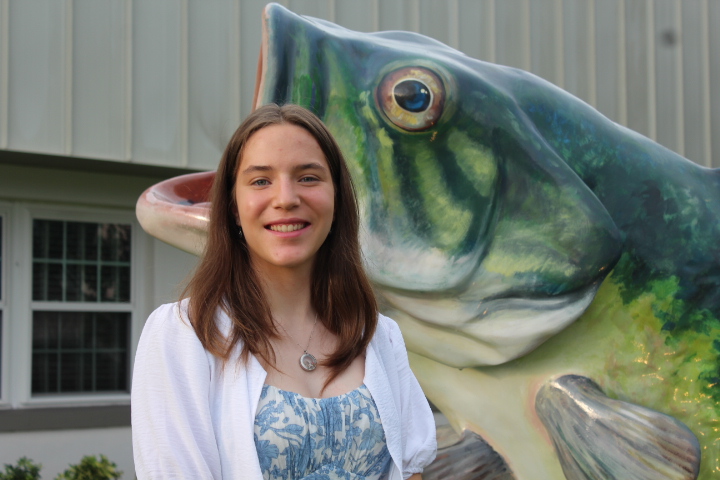
Amy Parrish, a 10th grader and Lake Alfred resident, won first place in the Patriots of the American Revolution DAR High School Essay Contest through the Lake Wales Chapter of the National Society Daughters of the American Revolution. She read her essay aloud at the ceremony.
The dedication ceremony was held at City Hall. The new Revolutionary War marker now stands at Gardner Park alongside the city’s existing Veterans Memorial, at the intersection of U.S. Highway 17/92 and Rochelle Avenue. The project was funded through an America Grant awarded to the city as part of the national America250 semiquincentennial commemoration.
Dara Hatten, America 250 Florida State Chairman for the Daughters of the American Revolution, served as keynote speaker. She presented on the topic “The Birth of a Nation.”
Heavy rain forced a change of venue for the unveiling, but Lake Alfred Parks and Recreation was ready. The ceremony remained indoors at City Hall, where the city showed a special video revealing the new Revolutionary War marker at Gardner Park, followed by trivia and a screening of the musical “Hamilton.”
The Patriots of the American Revolution contest is a national high school competition open to students in grades 9 through 12. Students select a figure from the Revolutionary era of 1773 to 1783 and write about that person’s contribution to the founding of the nation. Essays are judged on historical accuracy, originality, organization, and the quality of research, with particular weight given to the use of primary sources.

Your community. Your news. Your right to know. The Citrus Tea News.
Your community. Your news. Your right to know. Follow The Citrus Tea News for more across Polk County, or subscribe to our free e-Weekly newsletter at the link in our bio.
Amy, who turns 16 this month, chose Peter Francisco, a Portuguese-born boy who arrived in Virginia as an indentured servant and became one of the most celebrated soldiers of the war. Known as the Virginia Giant, Francisco fought across multiple major engagements, survived severe wounds three times, and was described by those who knew him as a one-man army.
Amy’s full essay appears below.
Happy Fourth of July, Polk County. Two hundred and fifty years in, and the story is still being written, one young voice at a time.
Peter Francisco: The Virginia Giant of the Revolution
By Amy Parrish, 10th Grade
Lake Wales, Florida Chapter (3-047-FL)
Patriots of the American Revolution DAR High School Essay Contest
1,180 words
Peter Francisco was an unsung hero of the American Revolution. This man was responsible for many victories for the Americans. He was a one-man army, soldiered through many years of hardship, and was a fighter and patriot from a young age. This is the story of a boy who encountered a tragedy when he was young but did not give up.
Peter Francisco was born on the island of Terceira, which is part of the Azores Island, about 950 miles away from Portugal. Peter was playing with his sister when he heard a bird chirping that sounded like an Azores buzzard, a rare and exotic bird. While Peter was searching for the bird, he ran into two sailors who lured him away with a rarity on the island: candy. The sailors promptly covered his head with a burlap sack, and one tossed Peter over his shoulder, running down the hill to the wharf. On June 23, 1765, their ship docked in the James River of Virginia, and the sailors left Peter on the docks, where he was found by the night watchman, Old Caleb. He noticed that the boy had two silver shoe buckles with the initials P.F. and was hefty for his age. Peter was given a home when a local judge, Anthony Winston, hired him as an indentured servant.
Peter grew at an alarming rate. At the age of twelve he weighed 200 pounds and was over six feet tall, and by fifteen was 260 pounds and six-foot-six-inches tall. In 2026, he would make a great NFL linebacker, but back in 1775 the average height of a full-grown man was five-foot-nine inches tall.
In March of 1775, Judge Winston took Peter with him for the meeting of the Virginia Convention at St. John’s Church. As an indentured servant, Peter wasn’t allowed to go into the meeting, but once the convention started, Peter sneaked to the side of the building and opened a window. Patrick Henry was delivering his vehement speech that would later become famous, and Peter listened intently as Patrick ended with these words: “Is life so dear, or peace so sweet, as to be purchased at the price of chains and slavery? Forbid it, Almighty God! I know not what course others may take, but as for me, give me liberty or give me death!”
Peter was so impassioned by Patrick’s speech that he expressed his desire to join the militia immediately. Judge Winston was enthralled by Peter’s desire but mentioned that Peter must wait until he was sixteen before he would be allowed to join.
Once Peter had enlisted, he waited over six months before he saw battle. He was in General Howe’s militia, which met with General George Washington’s men for the Battle of Brandywine on September 11, 1777, at Chad’s Ford, where the sun rose to the sharp sound of muskets firing on both sides. General Howe’s men rushed forward to stop the British from advancing any farther, defending the American rear guard and allowing them to escape. During the confrontation, Peter experienced a sudden sting in his left leg, but he ignored it in the face of the battle.
When the assault finally ended, an otherworldly silence fell over the battlefield and Peter looked down on his leg and saw blood had soaked his trousers. The sharp pain he had felt was a musket ball going straight through his leg. Peter was detached from the battlefield to a Moravian farmer’s home to receive medical attention, where he met and became friends with Marquis de Lafayette, who had been wounded.
When the assault finally ended, an otherworldly silence fell over the battlefield and Peter looked down on his leg and saw blood had soaked his trousers. The sharp pain he had felt was a musket ball going straight through his leg. Peter was detached from the battlefield to a Moravian farmer’s home to receive medical attention, where he met and became friends with Marquis de Lafayette, who had been wounded.
Even though Peter’s tour of duty had ended, he re-enlisted and was handpicked by George Washington to be one of the twenty men to attack the British fortification at Stony Point, New York on July 16, 1779. In the close quarter hand-to-hand combat that ensued, Peter suffered a nine-inch laceration across his stomach, but continued to fight, capturing the British flag in the process and holding it against his wound. His actions helped force a surrender from the British, and Peter’s bravery and fame spread across the colonies like wildfire just as his second tour concluded. He re-enlisted for a third tour.
On a moonless, sweltering night on Tuesday, August 15, 1780, the Virginia Militia marched to battle against Lord Cornwallis’ Army in Camden, South Carolina. The British were the first to attack. In a bombardment of bayonets and bullets, the Militia of Virginia and North Carolina dropped their weapons and ran for safety. As Peter was forced to retreat, he spied an American cannon about to be captured by the British. Peter beat off attackers, hefted the 350-pound cannon barrel on his shoulders, and carried it off the field toward a group of Continental soldiers. Peter sat under a tree to rest when a British soldier burst out in front of him with his musket drawn and told Peter to surrender or he would be killed. Peter, appearing submissive and fatigued, said that his musket was empty and offered it to the soldier. When the soldier grabbed for the musket, Peter spun the weapon around and plunged the bayonet into the man.
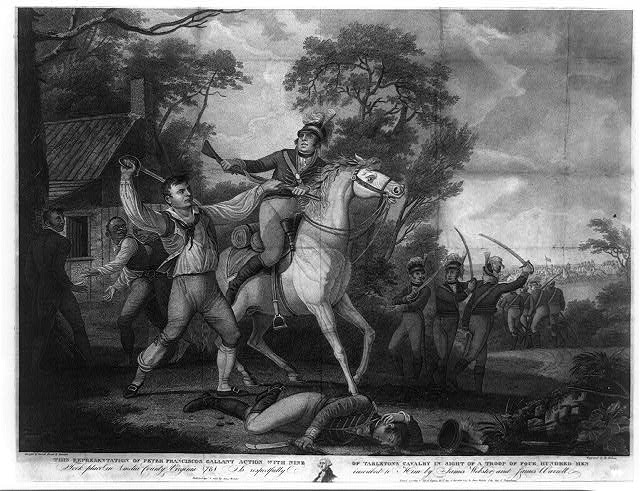
Later, Peter was given a six-foot broadsword with a five-foot blade by George Washington two days before the attack on Guilford Courthouse. Even though he fought bravely with his new sword, he was wounded by a bayonet, and the Americans lost the battle. After his third tour had ended, Peter was at a tavern in his town when nine of Tarleton’s Royal Dragoons wandered inside. Peter tried to get away but was surrounded by the men in seconds and forced to surrender. Peter was left outside with one Dragoon guarding him. The others were inside the tavern when the Dragoon spotted Peter’s silver shoe buckles with the initials P.F. and demanded he hand them over. Peter refused to give him the buckles, declaring that the soldier would have to come and take them himself. As the Dragoon drew near, Peter grasped the man’s sword and in one motion slashed the soldier’s head and neck. The Dragoon emitted one last cry for help, signaling the other Dragoons inside the tavern. When they dashed outside, they were faced by Peter, who killed another Dragoon while the other seven ran for their lives, and Peter was left with their horses.
Peter Francisco was known as the Virginia Giant, the Giant of the Revolution, a One-Man Army. A monument was erected in his memory and stands in New Bedford, Massachusetts. These words of General George Washington are inscribed on the monument: “Without him we would have lost two crucial battles, perhaps the War, and with it our freedom. He was truly a One-Man Army.”
From an indentured servant to an enlisted soldier, from an orphan to a patriot, Peter was a force to be reckoned with. Sitting under the open window at St. John’s Church, listening to Patrick Henry’s speech, something stirred in the heart of a fifteen-year-old boy. A patriot was born on that day, and his name was Peter Francisco, the Virginia Giant.
Bibliography
American Battlefield Trust. (2017, January 26). Peter Francisco: The Incredible Hulk of the American Revolution. American Battlefield Trust. https://www.battlefields.org/learn/articles/peter-francisco
Herald News. (1975, June 10). Peter Francisco Wielded Deadly Sword in Battle. SAILS Library Network. https://www.sailsinc.org/durfee/peterfrancisco.pdf
Newell, G. (2015). Peter Francisco. In R. Green, Legends of Liberty: Timeless Stories of Courageous Champions (pp. 178-200). Revolutionary Strategies.
Schellhammer, M. (2013, July 23). Peter Francisco: Distinguishing Fact from Fiction. Journal of the American Revolution. https://allthingsliberty.com/2013/07/peter-francisco-factor-fiction/
Sources: City of Lake Alfred. Lake Alfred America 250 Celebration event announcement. Facebook, facebook.com/mylakealfred. City of Lake Alfred. Lake Alfred America 250 Celebration ceremony reel. Instagram, instagram.com/p/DVWgaNpDOgD. Polk County Moms. Lake Alfred America 250 Celebration. polkcountymoms.com/event/lake-alfred-america-250-celebration. National Society Daughters of the American Revolution. Essay Contests. dar.org/outreach/education/essay-contests. National Society Daughters of the American Revolution. Patriots of the American Revolution DAR High School Essay Contest. member.dar.org/patriots-american-revolution-dar-high-school-essay-contest. City of Lake Alfred. Veterans Memorial. mylakealfred.com/294/Veterans-Memorial. Parrish, Amy. “Peter Francisco: The Virginia Giant of the Revolution.” Patriots of the American Revolution DAR High School Essay Contest, Lake Wales Chapter (3-047-FL), 2025-2026. Chapter First Place.