

Faster Isn’t Always Better: A Veteran’s Concern About the VA’s Race to Process Claims

By Jeffery Fogg
As a veteran, I want the Department of Veterans Affairs to succeed.
I want veterans to receive their benefits faster. I want fewer people waiting months or years for decisions. I want homeless veterans housed, appointments scheduled, and claims processed without unnecessary delays.
So when the VA announced this week that it has processed more than two million disability claims in record time, I genuinely see that as good news.
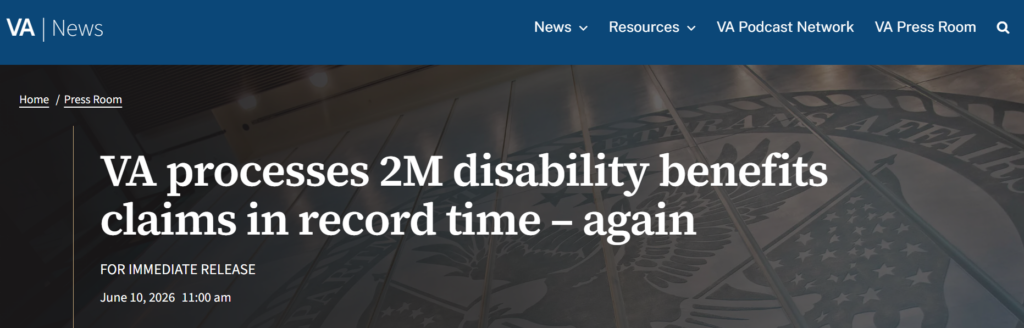
According to the VA, average decision times have dropped from 141.5 days in January 2025 to just 78.6 days today. The agency says its claims accuracy rate is above 94 percent, the highest level in two years. The backlog of claims waiting more than 125 days has reportedly fallen by more than 70 percent.
Those are impressive numbers.
But as someone who has worn the uniform, I can’t help but wonder what happens when speed becomes the primary goal.
Because every veteran’s story is different.
A missing leg isn’t just a missing leg. PTSD isn’t just a checklist. Traumatic brain injuries don’t always show up on a scan. Depression doesn’t always fit neatly into a box. The connections between military service, addiction, homelessness, failed relationships, unemployment, and suicide are complicated and deeply personal.
Yet increasingly, government agencies are turning to automation, algorithms, and artificial intelligence to move cases faster.
That worries me.
If the future of VA claims processing involves AI-assisted reviews and automated decision-making, who is making sure the computer actually understands the human being behind the paperwork?
Can a chatbot understand what it feels like to lose friends in combat?
Can an algorithm understand what it means to wake up every night reliving the same memory?
Can software recognize the connection between untreated trauma and years of substance abuse, homelessness, or failed marriages?
I don’t know that it can.
The VA points to a 94 percent accuracy rate. But veterans have reason to be cautious. Federal watchdog reports examining early PACT Act claims found thousands of improper denials and significant processing errors. Those reports focused primarily on claims from 2022 and 2023, not current claims, but they serve as a reminder that efficiency and accuracy are not always the same thing.
The question isn’t whether the VA should process claims faster.
Of course it should.
The question is whether speed is becoming more important than understanding.
A veteran’s disability claim is not a package being tracked through a warehouse. It is often the story of someone’s worst day, their worst injury, or the burden they have carried home from military service.
Those stories deserve more than a quick glance.
They deserve a real look by a real person.
Technology can help veterans. Artificial intelligence can help organize records, flag missing documents, and reduce administrative delays. Used properly, it can be a powerful tool.
But it should never become a substitute for human judgment.
Veterans are not data points.
We are not case numbers.
We are not percentages in a press release.
Every scar, every injury, every memory, and every struggle is unique.
As the VA continues its push toward faster decisions, I hope it remembers that the goal isn’t simply processing claims.
The goal is serving veterans.
And sometimes serving veterans takes more than speed. It takes understanding.