
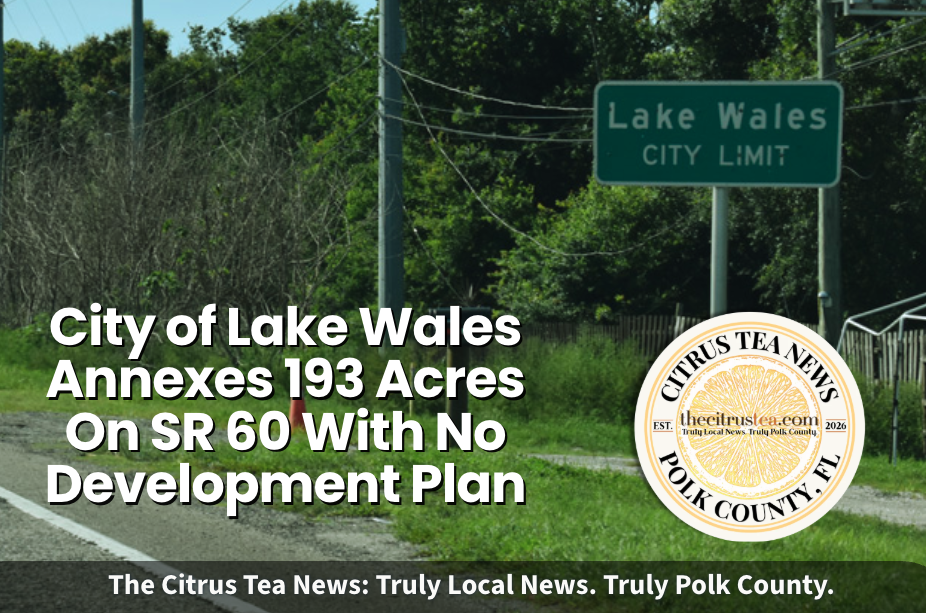
Lake Wales Annexation Of 193 Acres On State Road 60 Clears 4-1 With No Development Plan

Lake Wales commissioners voted 4-1 on Nov. 3 to annex 193.52 acres south of State Road 60 and clear the way for up to roughly one million square feet of industrial development, over objections from two residents, one commissioner, and a neighboring landowner who said his notice arrived the same day as the hearing.
The package the city approved moves the land in four steps. The city annexed the acreage with Ordinance 2026-29. Ordinance 2026-25 changed the future land-use designation from the county’s Agriculture Residential Rural to the city’s Industrial. Ordinance 2026-26 assigned I-1 Industrial zoning. The Planning and Zoning Board recommended approval on July 23, with the first reading on Aug. 18. Commissioner Gillespie cast the only vote against each of the four ordinances.
The applicant’s impact analysis projects 1,004,400 square feet of nonresidential industrial space at a floor area ratio of about 12 percent, well below the 50 percent maximum. The project has no development plan or completed traffic study. The analysis states only that the developer will provide a traffic impact statement once specific uses are identified.
Because no site plan exists, the city created a mechanism to attach conditions to the land. Ordinance 2026-28 added Section 23-406 to the city code, establishing Parcel Specific Land Use Conditions, and applied five conditions to the 193 acres.
First, industrial buildings must sit at least 200 feet from the residential parcels across West Lake Wales Road. Second, a 20-foot buffer along the southwestern boundary must carry four canopy trees and five understory trees per 100 linear feet, plus a fence, wall, or shrub at least six feet tall. Third, a matching 20-foot buffer is required along State Road 60, except where it would fall in a floodplain or wetland. The final two conditions, based on the Planning and Zoning Board’s recommendation, relate to stormwater, requiring the retention system to handle a 100-year, 24-hour storm event and meet Southwest Florida Water Management District discharge rates.
Growth Management Director Autumn Cochella told commissioners the mechanism is new and reusable. She said the city created the code section for exactly this situation, where land is annexed and assigned zoning before an end user is known, and that the conditions exceed the minimum standards already in the land development code.
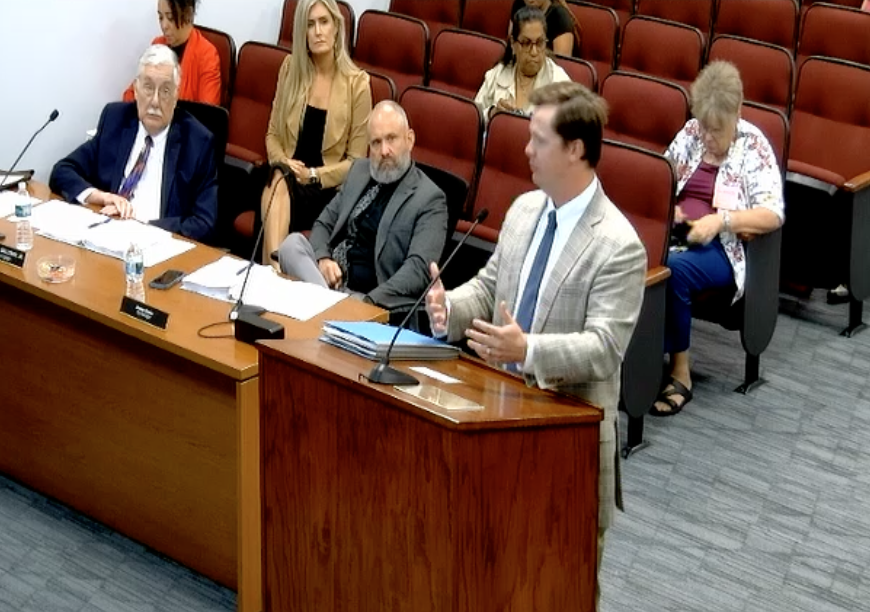
Shelton Rice, a land use attorney with Peterson and Myers in Lakeland representing the applicant, told commissioners the property meets the statutory requirements for annexation and could accommodate about a million square feet of distribution, logistics, warehousing, or manufacturing use.
Rice was direct about who his client is. “Our client is a developer, right?” he said. “They are not an end user.” He said the applicant is not obligated to complete a traffic assessment at this stage, describing it as a two-step process in which the study parameters are set first, and the study follows. He also said he does not have an end user in his back pocket and does not know what the eventual buyer would build.
Two residents asked the commission to slow down. Howard Davies asked members to table the request until they had a development plan and a traffic analysis in front of them. He told them annexation is a discretionary decision and that no property owner has an automatic right to annex into Lake Wales.
“We don’t need another promise on paper,” Davies said. “We need enforceable accountability that protects the public.”
Charlene Bennett told commissioners the owner comes to them with no development rights because the property is not yet inside the city limits.
Thompson rejected the framing that the city was acting prematurely and argued the opposite risk. He said the reason to annex is to give the city influence over what gets built, and without annexation, another jurisdiction would hold that authority. On the traffic question, he said there is no cart before the horse because there is no cart and no horse yet. He described the vote as being in charge of the city’s destiny.
Hilligoss said the sequence is routine. He told the chamber that the city has long annexed first and assigned land use afterward, and that many parcels carry industrial designations with no development plan attached.
Cochella said the city mailed notice to every property owner within 300 feet of the site three times, before the Planning and Zoning hearing, the first reading, and the second reading. A landowner who said he owns property directly across the road from the site told commissioners he received the notice that day and had not had adequate opportunity to review it. He raised concerns about wetlands on the site and the effect on nearby homes.

Truly Local news. Truly Polk County.
Your community. Your news. Your right to know. Follow The Citrus Tea News for real local news across Polk County, and subscribe to our free e-Weekly newsletter at the links below. We welcome your comments and questions. Send us a message to reach our team.
Frequently Asked Questions
What did Lake Wales annex on State Road 60?
The Lake Wales annexation covers 193.52 acres south of State Road 60 and east of West Lake Wales Road. The City Commission approved it 4-1 on Nov. 3, 2026, along with an industrial future land use designation and I-1 Industrial zoning.
How much development could go on the Lake Wales site?
The applicant’s impact analysis projects 1,004,400 square feet of nonresidential industrial space. The attorney for the applicant said the site could accommodate about a million square feet of distribution, logistics, warehousing, or manufacturing use.
Was there a traffic study for the Lake Wales industrial annexation?
No. The impact analysis states that a traffic impact statement will be provided during the development process once specific uses are identified. Two residents asked the commission to delay the vote until a traffic analysis was complete.
What are Parcel Specific Land Use Conditions in Lake Wales?
They are a new code mechanism created by Ordinance 2026-28 as Section 23-406, allowing the city to attach binding conditions to a property when it assigns land use and zoning without a site plan. Five were applied here, covering a 200-foot setback, two landscaped buffers and two stormwater standards.
Who voted against the Lake Wales annexation?
Commissioner Gillespie cast the only no vote on all four ordinances. Deputy Mayor Thompson, Commissioner Miller, Commissioner Williams and Mayor Jack Hilligoss voted yes.
Sources: City Commission Regular Meeting Official Agenda, City of Lake Wales, Nov. 3, 2026; Ordinance 2026-29, City of Lake Wales, Nov. 3, 2026; Ordinance 2026-25, City of Lake Wales, Nov. 3, 2026; Ordinance 2026-26, City of Lake Wales, Nov. 3, 2026; Ordinance 2026-28, City of Lake Wales, Nov. 3, 2026; Annexation and Land Use Impact Analysis staff memorandum, Growth Management Department, City of Lake Wales, Nov. 3, 2026; Lake Wales City Commission regular meeting, City of Lake Wales, Nov. 3, 2026