
Winter Haven Adopts 6.59 Millage Rate as Chad Davis Pushes to Tap Reserves for Tax Relief

Winter Haven city commissioners adopted a 6.59 millage rate for the 2026-27 budget year on Sept. 28, after rejecting Commissioner Chad Davis’s last-minute push to use $1 million in excess reserves to cut property taxes.
The rate passed 4-1, with Davis casting the only no vote. Commissioners then adopted the city’s $377,158,764 budget by the same 4-1 margin.
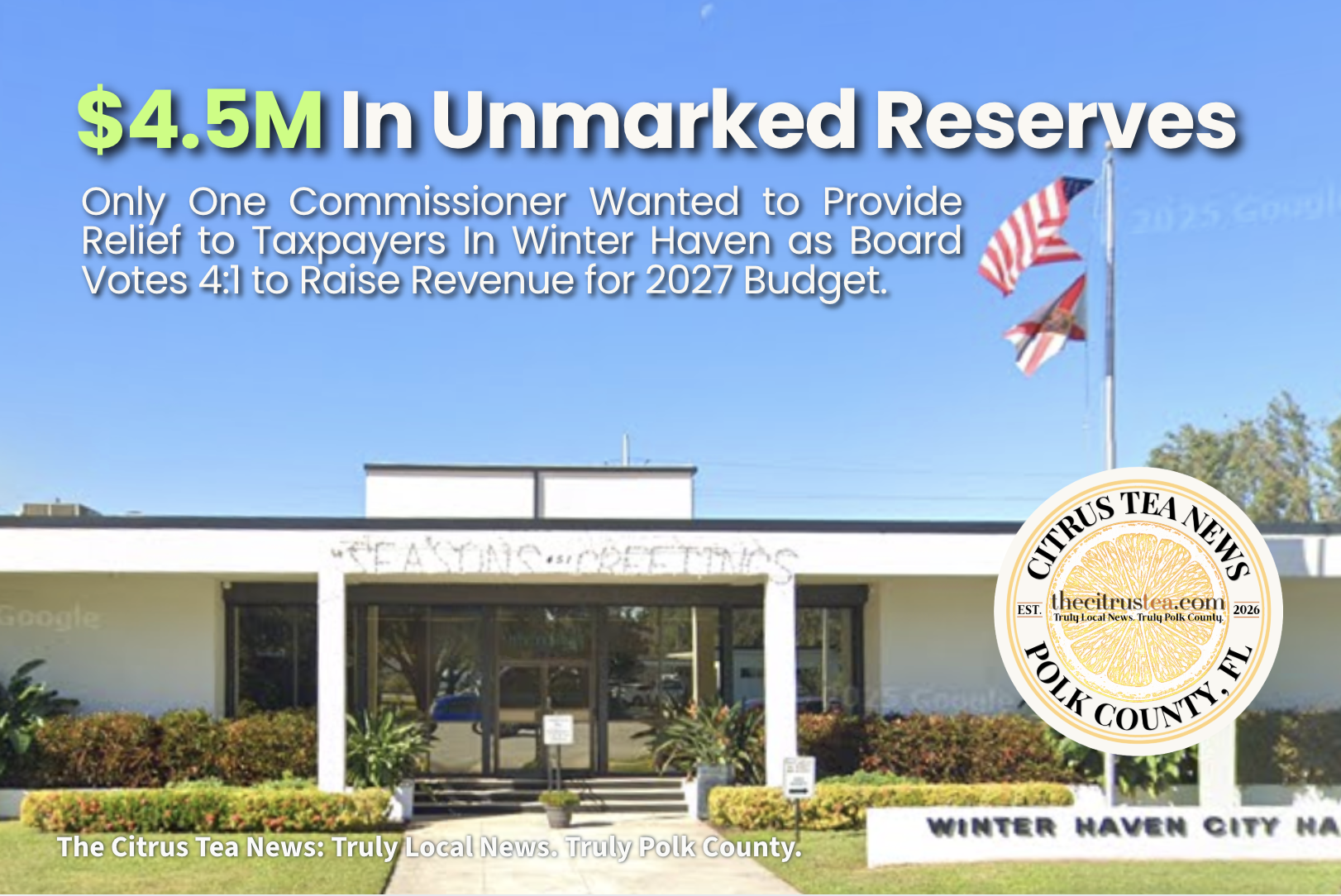
Before the final vote, Davis moved to amend the millage ordinance to 6.3888 mills. He said the cut would come from the city’s $4.5 million in unassigned fund balance, leave $3.5 million of that excess untouched and give Winter Haven the sixth-lowest millage rate in Polk County. The amendment failed.
“Something I learned in law school is that an impassioned dissent sometimes can win the long game,” Davis said as he began his closing remarks.
Winter Haven Keeps the Same Rate, Collects More Revenue
The 6.59 rate is the same one the city levies now. Because property values rose, it brings in more money than last year. It sits 0.51% above the rollback rate of 6.5567 mills, the rate that would have raised the same property tax revenue as the current year. The city advertised a notice of tax increase on Sept. 24, as state law requires.
At 6.59 mills, property taxes will bring $32,753,796 into the general fund at a 96.5% collection rate. Under a new state law, keeping the rate above the rollback rate required four votes from the five-member commission rather than a simple majority.
All five commissioners, including Davis, voted in July to set 6.59 mills as the proposed rate that went out on property owners’ TRIM notices. Davis said he changed course after learning in September that rolling back the rate would cost the city $165,509 in general fund revenue, not the $1.5 million commissioners were told earlier in the summer. He cast the only votes against the tentative rate and budget on Sept. 15.
Davis Calls Excess Reserves a “Slush Fund”
Winter Haven’s general fund balance is projected to reach 35% of the general fund by year’s end. Commission policy requires at least 17% and sets a goal of 30%. City Manager T. Michael Stavres has said $1.5 million of the amount above that goal is earmarked for Sertoma Park and recommended holding the remaining $3 million until the outcome of Amendment 3 and the city’s self-insurance costs are clearer.
Davis said the money above 30% is not an emergency reserve.
“Everything above 30%, by our own policy, is excess and money held above what is needed, reserved for unspecified or discretionary uses, has a name, a slush fund,” he said.
He said the $1 million proposal was one of several “trial balloons.” If commissioners had been open to it, he said, he intended to propose rolling back the full $4.5 million, which he estimated at roughly a full mill.
Davis, who has opposed Amendment 3 on the November ballot, said the vote undercut the argument he has made against it.
“I’m embarrassed tonight by how hard I have fought to oppose Amendment 3,” he said. “The taxpayers are exhausted. They do not trust us.”
He said he still opposes the amendment because of its effect on other cities and counties, but understands why voters support it.
“I do not budget based on hypothetical future political fights,” Davis said. “I budget based on the present.”
Mayor Yates: $50 a Year Is “Not Meaningful Change”
Mayor Brian Yates said the $1 million cut would have saved the owner of a $250,000 assessed home about $50 a year.
“That is not meaningful change,” Yates said. “Meaningful change is going back to the drawing board, making substantial cuts that are sustainable.”
Yates called pulling from the emergency fund “irresponsible.” He said the city could face higher fuel costs, new equipment needs or a disaster next year and be forced to raise the rate again. At the Sept. 23 agenda review, he also cited the need to pay bills while waiting on federal reimbursement after a major hurricane, and said he wants a series of meetings after this budget cycle to look for cuts in every area of the budget.
Commissioner Nathaniel Birdsong said the commission has raised the millage rate only once in more than 20 years, for road work, while the city’s population doubled. He said reserves carried the city through the economic downturn without raising taxes or cutting police, fire and emergency services.
Davis Votes No on Budget Over Nonprofit Grants
Davis said he supports most of the budget but voted against it for a second time because of the city’s grant-in-aid program, which the city’s July budget presentation listed at $358,500 for 42 nonprofit organizations.
He said some grant applications show the money going to salaries, benefits, consultants, marketing and travel for the organizations. He also said there is no cap on administrative costs for the grants, which leaves questions about how much of the money provides actual services to the community.
“Municipal government is not a funding arm for private organizations,” Davis said.
The Commission Pay Raise
Davis also proposed the commission pay raise the city adopted Sept. 15 in a 3-2 vote, with Yates voting no. Starting Oct. 1, commissioner pay rises from $17,525 to $24,180 a year and the mayor’s from $20,917 to $28,053.96, according to the city’s fact sheet and Davis’s May 17 memo. The raise replaces the 3% cost-of-living increase commissioners would otherwise receive and adds $31,026.60 to the budget.
In an interview with The Citrus Tea News, Davis said the raise does not conflict with his push for lower taxes.
He said residents are not upset “because we raised our compensation,” but rather because the commission did so “while also not lowering their taxes.”
“And I think both could have happened, and I think what we owe to the taxpayers was to give them some relief,” he said.
Davis said the new pay is in line with what other Polk County cities pay their commissioners for weekly meetings, events and preparation time. He based his figure on cities with more than 6,000 residents, which he said brought the benchmark down from closer to $27,000 or $28,000.
“It is public service, but it’s also a job,” he said.
Davis said former Commissioner Brad Dantzler, whose seat he won, raised the topic of commission pay in his farewell remarks.
Davis was elected to Seat 4 in 2025 and sworn in Jan. 12, 2026. This was his first budget cycle on the commission. He is a fourth-generation Winter Haven native and Winter Haven High School graduate and earned his law degree from Pepperdine University’s Caruso School of Law. His father was elected to the same commission nearly 50 years ago.
The new budget and millage rate take effect Oct. 1.
Disclaimer: The Citrus Tea News is an unbiased news outlet. We do not tell anyone how to vote, and we do our best to provide information that helps our readers decide for themselves.
Keeping Polk County informed is exactly why we’re here. Follow The Citrus Tea News for more local coverage, or subscribe to The Citrus Tea News e-Weekly at the link in our bio.
Correction: An earlier version of this article stated that Winter Haven Commissioner Chad Davis has been staff attorney for Polk County Public Schools since 2022. Davis has not held that position since July 2026, and the reference has been removed. The Citrus Tea News regrets the error.
Frequently Asked Questions
What is Winter Haven’s millage rate for 2026-27?
The Winter Haven millage rate for 2026-27 is 6.59 mills, adopted 4-1 on Sept. 28, 2026. It is the same as the current rate and 0.51% above the rollback rate of 6.5567 mills.
Did Winter Haven raise property taxes?
Winter Haven kept its millage rate the same, but because it is above the rollback rate, it brings in more property tax revenue than last year. The city advertised a notice of tax increase on Sept. 24, 2026.
How much is Winter Haven’s 2026-27 budget?
Winter Haven adopted a $377,158,764 budget on Sept. 28, 2026, in a 4-1 vote. It takes effect Oct. 1.
How much do Winter Haven city commissioners get paid?
Starting Oct. 1, 2026, Winter Haven commissioners earn $24,180 a year and the mayor earns $28,053.96, up from $17,525 and $20,917. The commission approved the raise 3-2 on Sept. 15, 2026.
How much money does Winter Haven have in reserves?
Winter Haven’s general fund balance is projected at 35% of the general fund, above the commission’s 30% goal and 17% minimum. That is about $4.5 million above the goal, with $1.5 million earmarked for Sertoma Park.
Sources: Interview with Commissioner Chad Davis, The Citrus Tea News, Sept. 29, 2026; City Commission Regular Meeting, City of Winter Haven, mywinterhaven.com, Sept. 28, 2026; City Commission Agenda Review Session, City of Winter Haven, mywinterhaven.com, Sept. 23, 2026; City Commission Regular Meeting, City of Winter Haven, mywinterhaven.com, Sept. 15, 2026; “City Commission Meeting Agenda Packet, September 15, 2026,” City of Winter Haven, winterhaven-fl.granicus.com, Sept. 15, 2026; City Commission Agenda Review Session, City of Winter Haven, mywinterhaven.com, Sept. 8, 2026; “Memorandum: Compensation Benchmark Analysis and Proposed Adjustments,” Commissioner Chad Davis, City of Winter Haven, May 17, 2026; “Honoring a Legacy, Continuing the Work: Winter Haven City Leadership,” City of Winter Haven, mywinterhaven.com, Jan. 13, 2026; Chad Davis, City Commission Staff Directory, City of Winter Haven, mywinterhaven.com, undated