
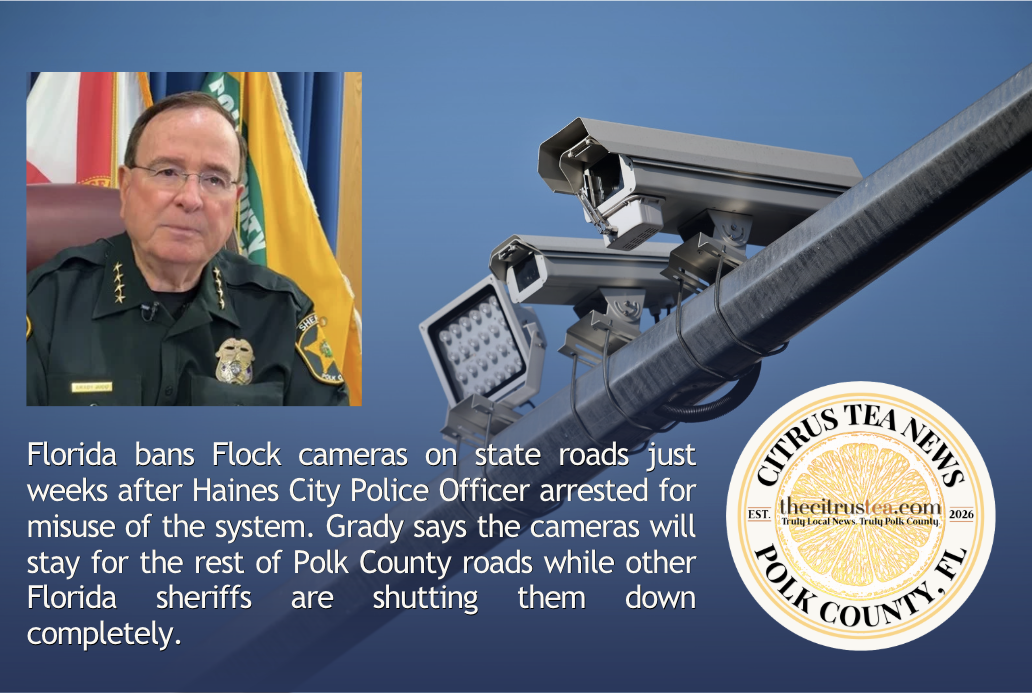
Sheriff Grady Judd Defends Flock Cameras As State Orders Them Off Florida Highways

Polk County Sheriff Grady Judd is pulling license plate readers off state highways under a new Florida Department of Transportation order, but he is keeping every camera his agency operates elsewhere, and his defense of the technology has revived a long-running question about why Polk County deputies still do not wear body cameras.
FDOT issued the memorandum Monday, Aug. 31, revoking all existing permits for automated license plate readers in state highway rights-of-way. Agencies have 30 days to take down the equipment. If they do not, the department said it will remove the cameras itself. FDOT also said it will not approve new installations.
The memo cited rapid growth in camera deployments along state roads, along with reports of misuse and data privacy concerns. Gov. Ron DeSantis, who called law enforcement’s use of the readers “out of control” days earlier, said Florida should not become a place where residents are tracked at all times. He has asked lawmakers to write permanent rules during the spring 2027 session.
State Highways and U.S. Routes affected
The order only covers the State Highway System, the roads FDOT maintains. In Polk County, that includes Interstate 4 and the U.S. routes 17, 27, 92, and 98, along with numbered state roads such as 33, 37, 60, 540, 544, and 559. Cameras on city and county roads can remain, and privately operated cameras on commercial property are untouched by the new memorandum.
Polk County Own Misuse of Flock Cameras
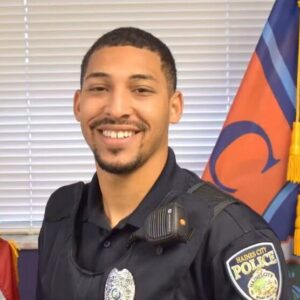
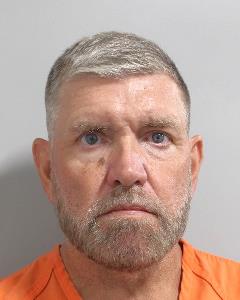
Christopher Anthony Goodson
The debate over misuse isn’t a stranger to Polk County. Three weeks before the state order, the Haines City Police Department announced the arrest of one of its own officers for using the Flock database to track his estranged wife.
Officer Christopher Anthony Goodson, 31, was charged Aug. 11 with one count of offenses against users of computers, computer systems, computer networks and electronic devices, and one count of official misconduct.
According to the arrest affidavit, Goodson searched his estranged wife’s license plate 717 times between Sept. 1, 2024, and June 30, 2026, both on and off duty.
Investigators said he logged some searches under reasons including wanted person and narcotics activity. His wife was never the subject of a criminal investigation.
The department said it was notified the evening of Aug. 10 and opened a criminal investigation immediately. Goodson told a supervisor he had been checking the vehicle to know where his children were. The affidavit states that admission came after he learned a Washington Post reporter had contacted his wife. Goodson had served since March 2022 and indicated he intends to resign. Police Chief Isaac Jackson said he has ordered additional quarterly reviews of how department staff access law enforcement databases.
Goodson has not been convicted. An arrest is not a finding of guilt, and he is presumed innocent unless and until proven guilty in a court of law.
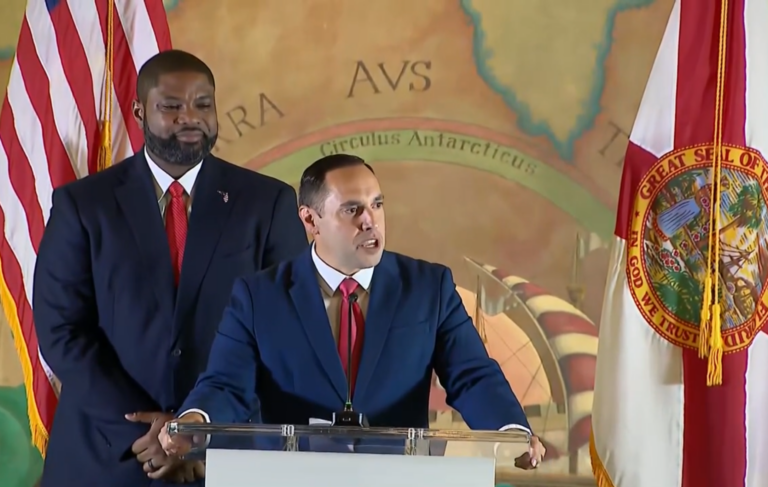
Judd responded Tuesday with an 11-minute video statement, opening by noting he has spent 54 years at the Sheriff’s Office. He called the readers the single best tool the agency has ever had for keeping the public safe and for locating people who drive away while suffering from Alzheimer’s or dementia. “We don’t need to do away with the best tool to keep you safe,” Judd said. He confirmed that his agency has begun removing units from state property and will continue using readers outside the state’s rights-of-way.
He said the cameras photograph tags and vehicles from a public right-of-way rather than people, and do nothing a deputy running plates from a parked patrol car could not do, only faster. He listed toll systems, red light cameras, school zone speed cameras, and school bus cameras as technologies that already track vehicle movement, and noted that patrol cars themselves carry license plate readers.
“Technology already knows everything about all of us.” – sheriff Grady Judd
Judd said the answer is written rules rather than removal, and that he will work with the Florida Sheriffs Association and the Legislature on standards covering privacy, auditing and accountability across all such technology. He said anyone who abuses the system should be fired, and in some cases, arrested.
Then he compared the readers to body-worn cameras.
“I am 100% in favor of privacy,” Judd said. “That’s why my deputies don’t wear body cameras, because they invade your personal privacy.”
He said body cameras record faces, enter private homes, and capture people at the worst moments of their lives.
Several Florida sheriffs have gone further by shutting down entire programs in their counties. The Jacksonville Sheriff’s Office said it will discontinue the technology citywide rather than only on state roads. Sheriffs in Franklin, Liberty and Putnam counties are ending their license plate reader programs entirely, and the Leon County Sheriff’s Office is turning off the cameras under its control. Pasco County is removing all 70 of its cameras from county and state rights-of-way, on a contract worth roughly $250,000, after commissioners voted to pull dozens from county land over Sheriff Chris Nocco’s objection. Hernando County had already begun removing cameras from county roads before the state acted. Judd is removing only what the memo requires.
The Polk County Sheriff’s Office is among the largest law enforcement agencies in Florida that do not equip deputies with body cameras. Judd has held that position for years, citing privacy and cost, and estimated in 2022 that outfitting the agency would run $4 million to $6 million a year.
No public budget document shows what the agency spends on license plate readers. The Sheriff’s Office publishes a 56-line program budget itemizing down to $66,570 for the Honor Guard and $17,680 for chaplaincy services. The words Flock, license plate reader, and automated license plate reader appear nowhere in the county’s 639-page budget book, which covers the current year and the proposed 2026-27 plan.
For Polk County drivers, cameras will come down along the interstate and the major state highways over the next month, and everything on local roads is here to stay.
Sources: Florida Department of Transportation Memorandum EOM26-01, fdot.gov, August 31, 2026; Sheriff Grady Judd video statement, Polk County Sheriff’s Office, September 1, 2026; State of Florida v. Christopher Anthony Goodson, probable cause affidavit, Haines City Police Department, August 2026; FY 2025/2026 and FY 2026/2027 Biennial Budget for Polk County Government, Polk County Board of County Commissioners, polkfl.gov; “Haines City Officer Used Flock Cameras to Track Estranged Wife on 717 Occasions, Affidavit Says,” WFLA, wfla.com, August 12, 2026; “Haines City Officer Arrested for Misusing Flock Cameras to Track Estranged Wife,” FOX 13 Tampa Bay, fox13news.com, August 12, 2026; “Haines City Police Officer Arrested After Allegedly Using FLOCK Cameras to Track Estranged Wife,” Daily Ridge, dailyridge.com, August 11, 2026; “A Wide Range of Reaction as the Removal of Flock Cameras From State Roads Begins,” WUSF, wusf.org, September 2, 2026; “FDOT Announces Removal of Flock Cameras Amid Privacy, Misuse Concerns,” NBC 6 South Florida, nbcmiami.com, August 31, 2026; “Gov. DeSantis Bans Flock Cameras From State Highways,” WCTV, wctv.tv, August 31, 2026; “DeSantis Bans Flock Cameras on State Roads in Florida,” The Washington Times, washingtontimes.com, August 31, 2026; “Part 3: Sheriff Grady Judd Has Faced Controversies, Protected Children,” LkldNow, lkldnow.com