Polk County Commission District 2 Candidates Split on Growth, Water and Data Centers

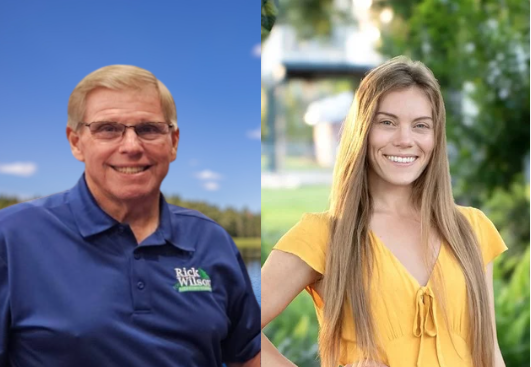
Two Republicans competing for the Polk County Commission District 2 seat agree the county is growing faster than its roads and water supply can handle. They do not agree on how to fix it.
Incumbent Rick Wilson and challenger Kelly Quinn both responded to a written questionnaire from The Citrus Tea News covering growth, infrastructure, the Upper Floridan Aquifer, data centers and Amendment 3. Their answers are published here in their own words, condensed for length. Their full answers, only corrected for minor punctuation and formatting, are posted at the end of this article.
The winner on August 18 will take the seat. Because both candidates are Republicans and no opposing party or write-in candidate qualified, there is no November contest for District 2, and Florida law opens the race to every registered Polk County voter regardless of party affiliation. Commissioners must live in the district they represent but are elected countywide, so voters in Lakeland and Davenport have the same say in this race as voters in Bartow and Frostproof.
A Party Endorsement Two Weeks Out
The Polk County Republican Executive Committee voted unanimously to endorse Wilson at a special meeting Monday, August 3. Chairman Sam Romain confirmed the vote to The Citrus Tea News. The party announced the endorsement publicly the following morning, saying more than a quorum was present and describing the outcome as “Not close. Not divided. Unanimous.”
Quinn, who is also a registered Republican, did not receive the party’s backing.
On their Experience
Wilson, first elected in 2018 and re-elected in 2022, framed his candidacy around institutional knowledge. “During my eight years of serving as Polk County Commissioner, I have gained immeasurable experience and knowledge in knowing how to get things accomplished,” he wrote, adding that he is “well-versed in the fact that there are rules, regulations and state mandates that often complicate matters” and that “simply having good intentions doesn’t necessarily get the job done.”
Quinn, a third-generation Polk County resident from Haines City, said she entered the race specifically because no one else had. “I entered this race when I saw that an incumbent would otherwise go unchallenged, despite major decisions affecting residents for generations,” she wrote. She pointed to her year on the citizen committee updating the Polk County Comprehensive Plan and described herself as “not a career politician” but “a prepared, independent advocate for the people who live here.”
Both listed community involvement outside the campaign. Wilson cited Bartow Rotary, the Bartow Chamber of Commerce, personal donations to Polk County Youth Fair exhibitors, an annual tire disposal event he hosts at his business under the Keep Polk Beautiful program, and volunteer work at the Lake Wales Care Center Thrift Store warehouse. Quinn cited conservation and water advocacy, work on wildlife corridors and aquifer recharge areas, research into the Polk Regional Water Cooperative and public comment on animal welfare and government transparency.

Both Say Growth Is the Problem
Asked to name the single biggest challenge facing residents, both named growth.
Wilson pointed the finger at city halls. “The majority of this growth has most recently come from the municipalities’ annexation of land and approving homes and development,” he wrote, stating that approximately 76 percent of new home permits were issued in the municipalities. “However, this growth affects everyone in Polk County as we all travel on the roads.” His remedy is road capacity. “I will certainly continue to approve any and all new road improvements and adaptations that are possible in order to mitigate the traffic problems.”
Quinn’s answer moved the question upstream, to whether projects should be approved at all. “Residents are paying through congestion, higher utility costs, flooding risks, declining service levels, and the loss of rural land, while too many developments are approved without their full long-term costs or footprints being addressed,” she wrote. She called for requiring demonstrated infrastructure capacity before major approvals, strengthening impact fees “so growth pays its fair share where impacts occur,” and evaluating projects for combined effects on water, transportation, emergency services and flooding. She also raised commuter rail connecting eastern Polk County to the Orlando job market as an alternative to continued road widening.
On how the county sets its infrastructure priorities, Wilson said he would continue evaluating each area individually and weighing staff recommendations “based on the significance of need at a given time and what can be done in an expedient amount of time and within the county’s budget restraints.”
On Amendment 3: Property Tax Relief
Amendment 3, the proposed constitutional amendment sent to voters by the Legislature during its June special session, would sharply increase the homestead exemption for non-school property taxes. It appears on the November 3 ballot and requires 60 percent approval to take effect.
Wilson declined to take a position. “I have made it my policy to leave the question of supporting Amendment 3 or not up to the voters, so I will respectfully decline to answer that. I believe the taxpayers are the ones who have the right to make that decision.” He added that he is “adamantly opposed to giving up our local control” and sees a current tendency to erode it.
Quinn opposed the measure as written. “Floridians need meaningful property-tax relief, but this amendment combines that goal with a sweeping state mandate that could destabilize local budgets, shift costs to renters and businesses, increase fees, and force service cuts,” she wrote. She also objected on local control grounds, arguing that Tallahassee should not constitutionally restrict how locally elected governments use locally collected revenue. “Lake Wales does not have the same fiscal conditions as Miami, and Haines City does not have the same priorities as Jacksonville.”
What about Water and Data Centers?
The questionnaire asked both candidates about the Upper Floridan Aquifer, the Polk Regional Water Cooperative and large industrial water users including data centers, a subject that has driven public fights in Fort Meade, Lakeland and Haines City this year.
Wilson said he would keep working with the Southwest Florida Water Management District, the Department of Environmental Protection and the water cooperative to reach consensus on acceptable projects. On data centers, he made a direct commitment. “Polk County does not currently have a Land Use designation to approve a Data Center. However, should that possibility present itself in the future, I would proceed with an abundance of caution and not vote for approval of a Data Center or any other industrial business that would negatively impact the future water supply for our county.”
Quinn called the Upper Floridan “a public trust and Polk’s primary drinking-water source” and said cooperative decisions “must account for Florida’s documented history of injected wastewater migrating upward through Floridan formations, not assume deep disposal is risk-free.” Pumping the Lower Floridan, she wrote, requires independent modeling and continuous monitoring because drawdown can reach the Upper Floridan and affect lakes, wetlands and private wells.
Your community. Your news. Your right to know. The Citrus Tea News.
Follow us on Facebook and Subscribe at thecitrustea.com for breaking news and weekly updates from The Citrus Tea News.
On industrial users, Quinn said large operations “should receive no permits or incentives without independently verified water impacts,” and that any claimed closed-loop cooling system “must be proven through design and operation, with blowdown volumes, treatment, testing, reuse, and disposal disclosed and properly managed.” She also proposed a regional Water Stewardship Fund with neighboring counties, municipalities and water management districts to protect recharge areas.
Closing Arguments
Wilson closed on record and relationships, describing a donor list that included ranchers, citrus growers, law enforcement, educators, realtors and builders, health care workers and retirees. “I am the best candidate for the job,” he wrote. Wilson also cited Sheriff Grady Judd’s endorsement in his questionnaire response.
Quinn closed on access. “My campaign is grassroots because county government should answer to its residents, not the loudest or most connected interests,” she wrote. She urged all voters to participate, noting that the primary is open to every registered voter in the county.
How and When to Vote
The primary election is Tuesday, August 18. Voters can confirm their registration, find their polling place, and view their sample ballot through the Check Your Information tool at PolkElections.gov.
The county’s other commission race will not appear on the August ballot. In District 4, Republican Omar Arroyo faces write-in candidate Elisha Gresham in the November 3 general election, with Commission Chair Martha Santiago stepping down at the end of her second term. Neither District 4 candidate submitted questionnaire responses before publication.
The Citrus Tea does not endorse candidates. Questionnaires were sent to every qualified candidate in these races with identical questions and identical deadlines. Responses are the candidates' own and have been condensed for length, not altered for content.
Sources: Rick Wilson, questionnaire response to The Citrus Tea News, August 4, 2026; Kelly Quinn, questionnaire response to The Citrus Tea News; Sam Romain, Chairman, Polk County Republican Executive Committee, interview, August 2026; Polk County Supervisor of Elections, polkelections.gov; Polk County Campaign Finance Reporting, voterfocus.com; Polk County Board of County Commissioners, District 2, polkfl.gov; Florida Division of Elections, dos.fl.gov; House Joint Resolution 1-F, The Florida Senate, flsenate.gov; Polk County Republican Executive Committee, facebook.com, August 4, 2026; Rules of Procedure, Republican State Executive Committee, Republican Party of Florida