
Polk County Sheriff’s Office Autism Decal Program Has Helped Families Since 2022. It’s not too late to Register

A Polk County mother’s concern for her son started it all.
When her child was pulled over by a deputy, he was scared and struggled to communicate, reacting in ways that could easily be misread by a first responder with no context. She brought that experience to Sheriff Grady Judd, and within months, the Polk County Sheriff’s Office had built a program around it.
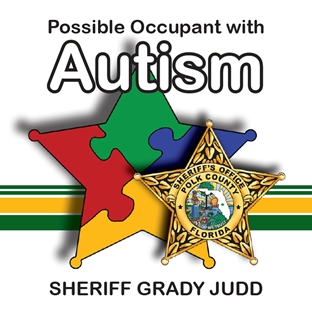
The PCSO Autism Decal Program launched April 19, 2022, offering free decals for homes and vehicles that alert deputies before they ever reach the front door or approach a car window. On the first day alone, the sheriff’s office received 300 requests.
More than three years later, the program remains free, open to all Polk County residents, and still underused by many of the families who need it most.
The program provides participants with a decal to display on their home or vehicle, along with a registration form. Information from the form is entered into a database that flags the address in the PCSO dispatch system. When deputies are called to a registered home, they will be notified before arrival that they may encounter someone with autism.
“Our deputies are trained on the unique characteristics, behaviors, and needs of people with autism,” Sheriff Judd said. “When a deputy sees one of these stickers, or responds to a home that has registered for this program, he or she will know they might interact with someone who has difficulty communicating or interacting with others. This enables us to better communicate with those who have special needs.”
The program is also personal for Judd. His grandson is on the autism spectrum. “Most wonderful, kind, gentle, smart, intelligent person that I’ve ever met,” Judd has said. “But you need to know that things upset him that may not upset the child without autism.”
Residents who do not wish to display a decal can still fill out the registration form to have their address entered into the dispatch database without a visible sticker on their property or vehicle.
What Signs Should Parents of Young Children Be Looking For?
Autism is more common than many families realize. According to data released by the Centers for Disease Control and Prevention in April 2025, autism rates have risen to roughly 1 in 31 children aged 8 in the United States, up from 1 in 36 in the previous reporting period. Boys continue to be diagnosed at significantly higher rates than girls, though experts note that autism in girls is frequently missed or misdiagnosed because it can present differently.
Early signs can appear in the first year of life, but the average age of diagnosis in the U.S. remains around 4 years. That gap matters. Research has shown that children who receive early intervention services before age 3 show significantly greater improvements in communication, cognitive ability, and social skills compared to those who start later.
The American Academy of Pediatrics recommends specific autism screening at 18 and 24 months as part of routine well-child visits. Experts strongly advise against a “wait and see” approach. If a parent has a concern, the first step is to bring it to the pediatrician immediately, without waiting for a scheduled appointment.
CDC Reference Guide
Autism Red Flags by Developmental Age
Signs of autism can appear in the first year of life. The earlier a family acts, the better the outcome. If your child is showing any of the signs below, bring them up with your pediatrician right away. Do not wait for a scheduled visit.
| Age | Signs That May Warrant a Conversation With Your Pediatrician | Act If You See |
|---|---|---|
| 2–6 months | Not making eye contact; not smiling or responding to smiles; limited facial expressions; not reacting to sounds or voices | No social smile by 6 months |
| 9 months | Not babbling; not sharing sounds, smiles, or facial expressions back and forth with caregiver; limited response to name | No back-and-forth sounds or expressions |
| 12 months | Not babbling; not pointing, waving, or using other gestures; not responding to name when called; limited interest in other people | No babbling or gestures by 12 months |
| 15–18 months | No single words; not pointing to show interest in something; no pretend play (e.g., pretending to talk on a phone); not following when caregiver points to something | No words by 16 months; no pointing |
| 24 months | No two-word phrases spoken independently; limited interest in other children; repetitive movements (hand-flapping, rocking, spinning); lining up toys rather than playing with them; intense reactions to sounds, textures, or lights | No two-word phrases by 24 months |
| Any age | Restricted or fixated interests; unusual attachment to objects; difficulty with changes in routine; limited eye contact; very little interest in peers; sensory sensitivities | Patterns that emerge over time |
| Any age — Urgent | Loss of any previously acquired speech, language, or social skills at any age. This regression affects roughly 1 in 5 children with autism and typically appears between 15 and 30 months. | Seek evaluation immediately |
Source: CDC Learn the Signs. Act Early. program, cdc.gov/act-early • American Academy of Pediatrics developmental screening guidelines • This table is for informational purposes and is not a substitute for professional medical evaluation.
Where to Start When You Have Questions
Florida has a structured pathway for families at every age, and none of it requires a private diagnosis or insurance to begin.
For children from birth through 36 months, Florida’s Early Steps program provides free early intervention services to infants and toddlers who have or are at risk for developmental disabilities. Families can ask their pediatrician for a referral or call 2-1-1 for a free, confidential connection to local services.
Once a child reaches 34 months and is not yet enrolled in public school, Florida’s Child Find program takes over. Child Find specialists, through the Florida Diagnostic and Learning Resources System and in partnership with the local school district, offer free developmental screenings with no insurance required and no doctor’s referral needed. Parents can contact Child Find directly if they have concerns about a child’s speech, behavior, learning, or development.
At age 3, the Polk County Public Schools Exceptional Student Education Department becomes the primary resource. The ESE Department serves eligible children and young adults from age 3 through 22 and works with families to develop Individualized Education Plans based on each student’s strengths and needs. Services include speech therapy, occupational therapy, physical therapy, and specially designed instruction. Parents who suspect their child may need services and do not yet have an IEP can call Polk County’s Child Find line directly at 863-535-6486.

Your community. Your news. Your right to know. The Citrus Tea News.
Follow us on Facebook and Subscribe at thecitrustea.com for breaking news and weekly updates from The Citrus Tea News.
Polk County families also have access to CARD-USF, the Center for Autism and Related Disabilities at the University of South Florida, which serves Polk County among 14 counties in its region and offers all services free of charge. CARD consultants can assist parents with evidence-based practices for skill-building and behavioral concerns, school observations, IEP guidance, and planning for transitions into adulthood. Support is available by phone, video, email, or in person. CARD-USF can be reached at (813) 974-2532 or at card-usf.fmhi.usf.edu.
To participate in the PCSO Autism Decal Program, email [email protected]. A Crime Prevention Specialist will respond with the registration form and additional information. The program is free and open to all Polk County residents.
Sources: Polk County Sheriff’s Office, polksheriff.org/autism-decal; PCSO news release, April 19, 2022, polksheriff.org/news-investigations/2022/04/19/pcso-unveils-new-autism-decal-program-to-help-deputies-identify-those-with-needs; WFLA News Channel 8, “Polk sheriff launches decal program to alert responders to people with autism,” April 20, 2022; Fox 13 Tampa Bay, “Polk County Sheriff’s Office creates autism decals for those with special needs,” April 23, 2022; Centers for Disease Control and Prevention, ADDM Network Autism Prevalence Report, April 2025; Centers for Disease Control and Prevention, Learn the Signs. Act Early., cdc.gov/act-early
CARD-USF, Center for Autism and Related Disabilities, University of South Florida, card-usf.fmhi.usf.edu, (813) 974-2532
Polk County Public Schools Exceptional Student Education Department, polkschoolsfl.com/about/departments/ese, Child Find: 863-535-6486; Florida Diagnostic and Learning Resources System, Child Find program, fdlrs.org/child-find
Florida Early Steps program, autismfl.org; Focus Therapy Florida, “Navigating an Autism Diagnosis in Florida: The First Steps,” focusflorida.com, February 2025; American Academy of Pediatrics, developmental screening guidelines