
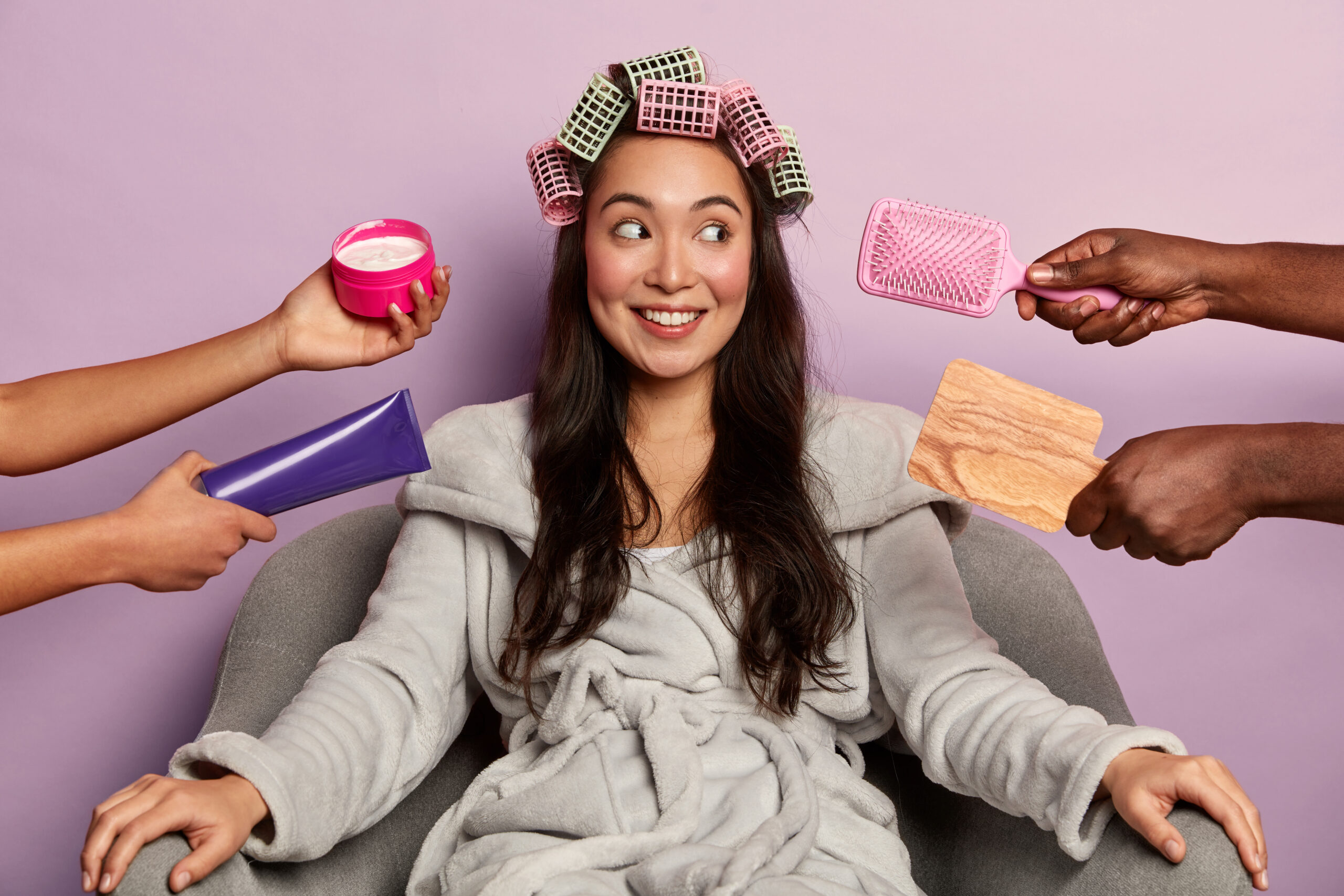
Mindful Beauty: The Evolution Of Hair Solutions

This is an opinion column.
We have come a long way from the kitchen sink and a bar of soap. The story of haircare is a story of self-discovery — and right now, the tools at our fingertips have never been better. Here’s how to use three of them.
For most of human history, haircare was simple by necessity. Ancient Egyptians scented their hair with castor and almond oils. Greek women rinsed with olive oil and herbs. In the Victorian era, women brushed one hundred strokes a night and passed homemade pomades down through generations. Hair was tended to with whatever the earth provided — and somehow, it was enough.
Then came the twentieth century, and with it, a revolution. The first commercial shampoo arrived in the 1930s. The permanent wave machine — a magnificent, terrifying contraption of cables and clamps — promised transformation in a single salon visit. Hairspray, hot rollers, relaxers, and keratin treatments followed decade by decade, each promising to solve whatever the last product created. We went from natural oils to sulphate-heavy lathers and back to natural oils again. We big-chopped, we bleached, we embraced our texture, we straightened it, then embraced it again.
What this long, winding, wonderfully messy history tells us is this: women have always cared deeply about their hair — not out of vanity, but because hair is identity. It is culture. It is self-expression worn on the body every single day. And today, with decades of science and artistry behind us, we finally have the knowledge to care for it smarter, not harder.
So let’s talk about three of the most effective, most underestimated solutions available to you right now — solutions that aren’t about chasing a trend, but about giving your hair exactly what it needs to thrive.
Solution One: The Haircut — shape is everything
Let’s address the elephant in the salon: the fear of the scissors. If you are on a hair growing journey — nurturing your hair, willing it to grow, measuring it against your shoulder with quiet hope — the idea of a haircut can feel like a step backwards.
But here is what I want you to consider: length without shape is just length. And length without health is just damage you’ve been carrying a long time.
A well-executed haircut does something that no serum or mask can replicate — it gives your hair architecture. It removes the split, frayed, and broken ends that have been travelling up the hair shaft and weakening the strands above them. It creates movement. It frames your face with intention. And perhaps most powerfully, it creates the optical illusion of fullness and health that no amount of growing can achieve on its own.
Think of a haircut not as a subtraction, but as an edit. The best editors don’t remove what is good — they remove what is holding the good back. Your stylist shouldn’t be the enemy in your hair growth journey. They are your guide and collaborator.
Ask for a “dusting” or “shaping’, where your stylist removes only the damaged ends, often less than half an inch, while preserving as much length as possible.
Solution two: The Colour Gloss — radiant looking hair without a new color commitment.
When most people hear “hair colour,” they picture foils, bleach, dramatic transformations, and a six-week commitment to roots. And while there is absolutely a time and place for all of that, colour does not have to be a statement to be effective. Sometimes, the most beautiful thing colour can do is simply make your hair look more like itself — only better.
Enter the colour gloss. Think of it as a top coat for your hair — much like a clear or tinted gloss on a nail. It deposits a sheer veil of tone that sits close to your natural or existing colour, smoothing the cuticle as it works and flooding each strand with light-reflecting shine. The result is not a new colour. It is your colour, turned up. Richer. More dimensional. More alive.
A gloss is also one of the kindest things you can do for chemically treated or heat-styled hair, because the process is gentle and the payoff is immediate. Dull, flat, lacklustre hair — the kind that seems to absorb light rather than reflect it — responds to a gloss treatment the way a dry garden responds to rain. Within a single appointment, hair can go from tired to luminous without a single dramatic change.
For those who have always been curious about colour but nervous about commitment, a gloss is the perfect introduction. It fades gracefully, causes minimal damage, and leaves the door wide open for you to go further — or simply come back and do it again.
Ask your stylist for a “toning gloss” or “glaze” in a shade one level deeper or warmer than your natural tone — it adds richness and glow without any visible grow-out line.
Solution three: Hair Botox, Keratin & Amino Acid Treatments
If the haircut is the sculptor and the gloss is the artist, then a restorative treatment is the healer. And for hair that has been through the fire — literally and figuratively — healing is exactly what is needed before anything else can work properly.
Hair Botox, keratin, and amino acid treatments are three powerful options, each working slightly differently but united by the same goal: to replenish what heat, chemicals, stress, and time have stripped away.
Hair Botox is a deep conditioning treatment packed with proteins, vitamins, and fatty acids that fill in the gaps along the hair shaft — those microscopic cracks and holes left behind by damage — restoring smoothness, elasticity, and softness. Despite the name, there are no actual injections; it works from the outside in, and it is suitable for almost all hair types.
Keratin treatments focus on the protein that hair is fundamentally made of. When keratin levels are depleted — as they inevitably are through chemical processing and heat styling — hair loses its resilience and begins to break, frizz, and resist styling. A keratin treatment essentially re-coats the hair in its own building blocks, sealing the cuticle and restoring a smoothness that can last months.
Amino acid treatments are the gentlest of the three and work at the deepest structural level, bonding directly to the internal cortex of the hair strand to rebuild strength from within. They are particularly well suited to hair that is fine, fragile, or naturally textured, as they strengthen without weighing hair down.
The right treatment depends on your hair’s specific history and needs — but know this: damaged hair is not a life sentence. It is a starting point.
Always consult your stylist before choosing between these treatments — the wrong one for your hair type can temporarily worsen porosity. The right one can genuinely transform your hair’s health within a single session.
Here is what I want you to leave with today: your hair is not a problem to be solved. It is not a project you are failing at, a before photo waiting for its after, or a reflection of how well you have or haven’t taken care of yourself. Your hair is alive. It responds. It has a history. And like you, it is entirely capable of transformation when it receives the right kind of attention and care.
The three solutions we have talked about today are not quick fixes — they are investments. In your hair’s health, yes, but more than that, in the relationship you have with yourself every morning when you stand in front of the mirror. Because when your hair feels good, truly good — shaped with intention, glowing with vibrancy, strong and resilient from root to end — something shifts in the way you carry yourself into the world.
You don’t need to wait until your hair is “fixed” to feel beautiful in it. Start where you are. Choose one thing. Book the appointment. Take the step. Your best hair isn’t somewhere in the future — it’s waiting for you to decide that right now, today, you are worth the effort.
Because you are. You always have been.
Read more Mindful Beauty: The Chicken or the Egg? Which Beauty Comes First?